Specialty Sintered Plates (Graded & Mesh-Reinforced)
One alloy, two ratings, each layer doing its own job - and a mesh option for pulse duty
Overview
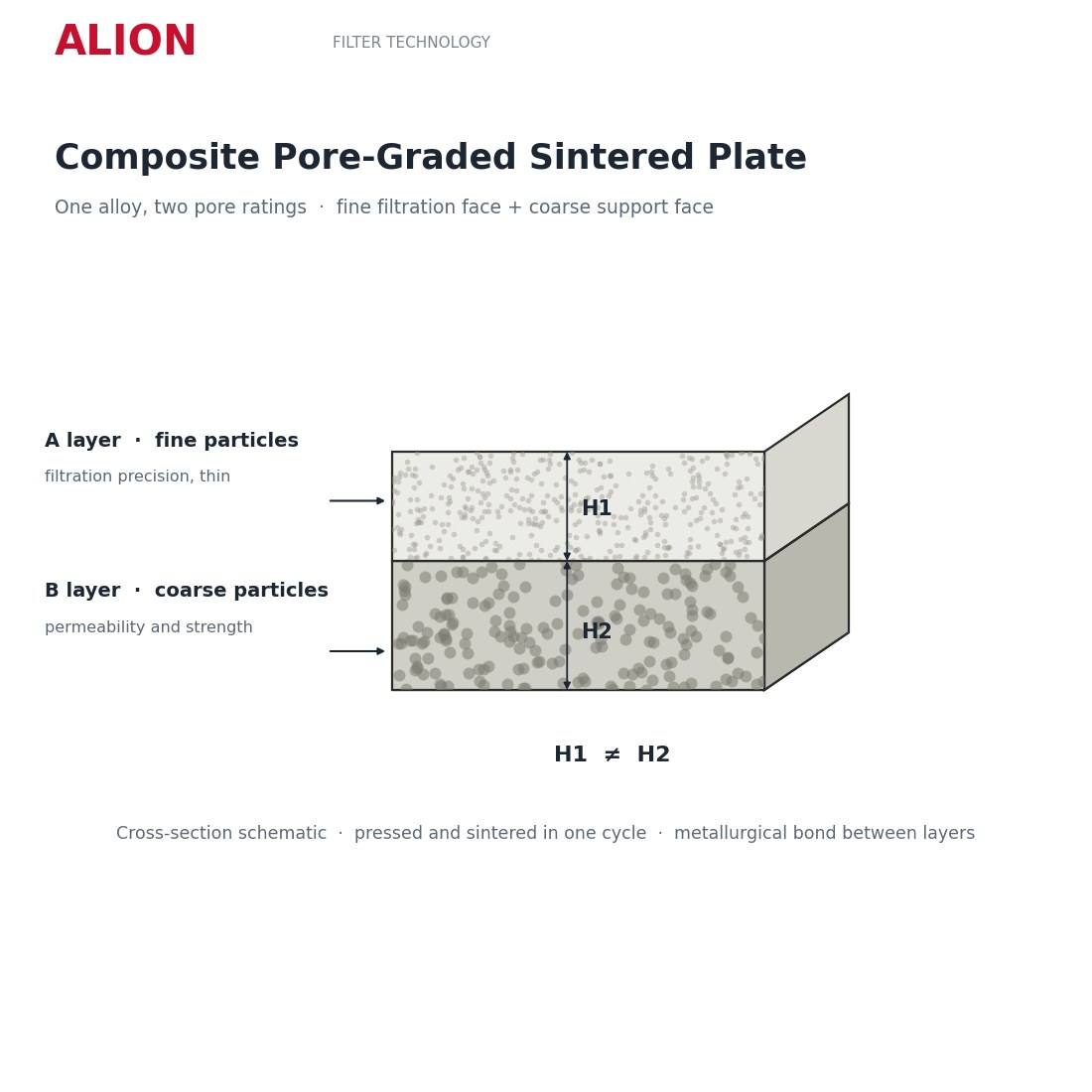
One plate, two ratings, two jobs: the fine A layer carries filtration precision, the coarse B layer carries permeability and strength. Pressed together and sintered in one cycle, the layers bond metallurgically - no adhesive, no delamination, no particle shedding. Layer thickness and rating are ratioed to the duty (H1 ≠ H2), so the plate filters finer and survives more than a single-layer build.
For high backpulse frequency and pulsing gas flow, a sintered wire-mesh reinforcement can be added at the surface: mesh raises surface strength and scouring resistance, visibly extending life. Mesh and powder layer are sintered together - again a metallurgical bond.
After forming, laser cutting produces round holes, flange holes, sectors and profiles in one pass with clean edges ready to fit. Catalytic combustion premix plates, fluidized-bed profile distributors and burner manifolds - duties that need precision and shape together - are built on this line.
Do not confuse this page with dual-material composite: this page is one metal with two ratings (coarse support + fine filtration). If you need two different metals - 316L face against C276 face, or a 316L inner tube with an Inconel 600 outer - see the dual-material page.
Specifications
| Structure | Dual-rating graded pressing / mesh-reinforced (cross-sections on request) |
|---|---|
| Rating | Layer A 0.2-20 μm + layer B 20-100 μm, ratioed to duty |
| Total thickness | 3 - 30 mm class (layer ratio adjustable) |
| Process | Composite pressing → single sintering → laser cutting |
| Materials | Titanium and stainless series mainly (other alloys by duty review) |
| Typical use | Catalyst support, premix combustion manifolds, high-intensity backpulse |
FAQ
- Graded plate vs two stacked plates?
- The graded plate is one sintered body - no interface to gap, shift or shed between layers, and better thermal cycling behavior.
- Can the fine layer be 1 μm?
- Layer A runs 0.2-20 μm; tell us the target and we confirm the ratio at sampling.
- Mesh on which side?
- Usually the flow-face side that takes the scouring; both sides possible for reversing flow.
Send your medium, temperature, pressure and target rating to [email protected] - drawings and annual quantities welcome. Free samples; material certificate and measured bubble-point / permeability data with every batch. Lead time 7-15 days standard, 10-20 for composite builds.
Email [email protected]