Dual-Material Composite Sintered Filters
Two metals, one part - corrosion face and pressure face designed separately, sintered into a single body
Overview
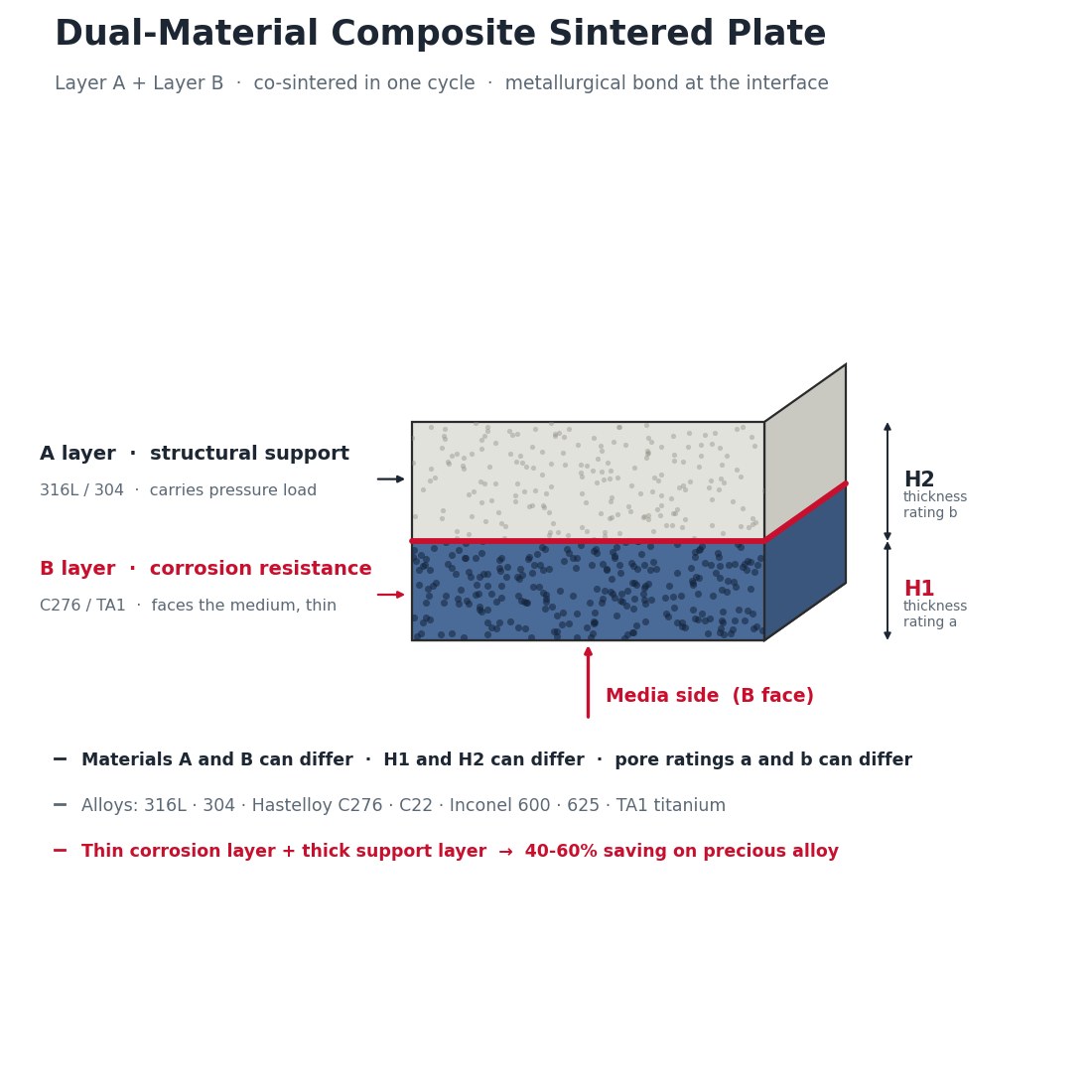
A standard sintered filter is one metal throughout: a 316L plate is 316L from surface to core, a C276 tube is C276 inside and out. That forces a compromise - choose the alloy for corrosion and you overpay for strength; choose it for strength and corrosion wins somewhere. The dual-material composite removes that compromise: two metal powder layers are filled, pressed and sintered in one cycle, so the media-facing layer takes the corrosion and the structural layer carries the load. The interlayer is a metallurgical bond (grains grow across the boundary), not glue and not a mechanical lap - it will not delaminate or shed particles.
Typical builds: 316L inner + Inconel 600 or 625 outer tube; 316L face + Hastelloy C276 face plate; 316L + TA1 titanium. Each layer has its own thickness and its own micron rating - for example a 5 μm corrosion face over a 40 μm pressure face. Tell us the medium, temperature and pressure; we propose the pair and the layer split.
Specifications
| Material pair | 316L + C276/C22, 316L + Inconel 600/625, 316L + TA1 Ti, or per medium |
|---|---|
| Layer thickness | Independently set per layer; corrosion layer thin, load layer thick (total 2-20 mm class) |
| Rating | Set per layer, e.g. 5 μm corrosion face + 40 μm pressure face |
| Bond | Composite pressing + high-temperature sintering, metallurgical (no adhesive layer) |
| Forms | Plates and tubes, made to drawing |
| Typical use | Corrosion + pressure combined, high temperature + corrosion, single-face corrosion |
FAQ
- Will the two layers separate?
- No. The interface is a sintered metallurgical bond - powder grains interlock across the boundary. We can supply a cross-section sample so you can verify before batch.
- Can each layer have a different micron rating?
- Yes, rating and thickness are set independently per layer.
- Lead time?
- Composite needs one extra sintering pass: normally 10-20 days instead of 7-15.
Send your medium, temperature, pressure and target rating to [email protected] - drawings and annual quantities welcome. Free samples; material certificate and measured bubble-point / permeability data with every batch. Lead time 7-15 days standard, 10-20 for composite builds.
Email [email protected]